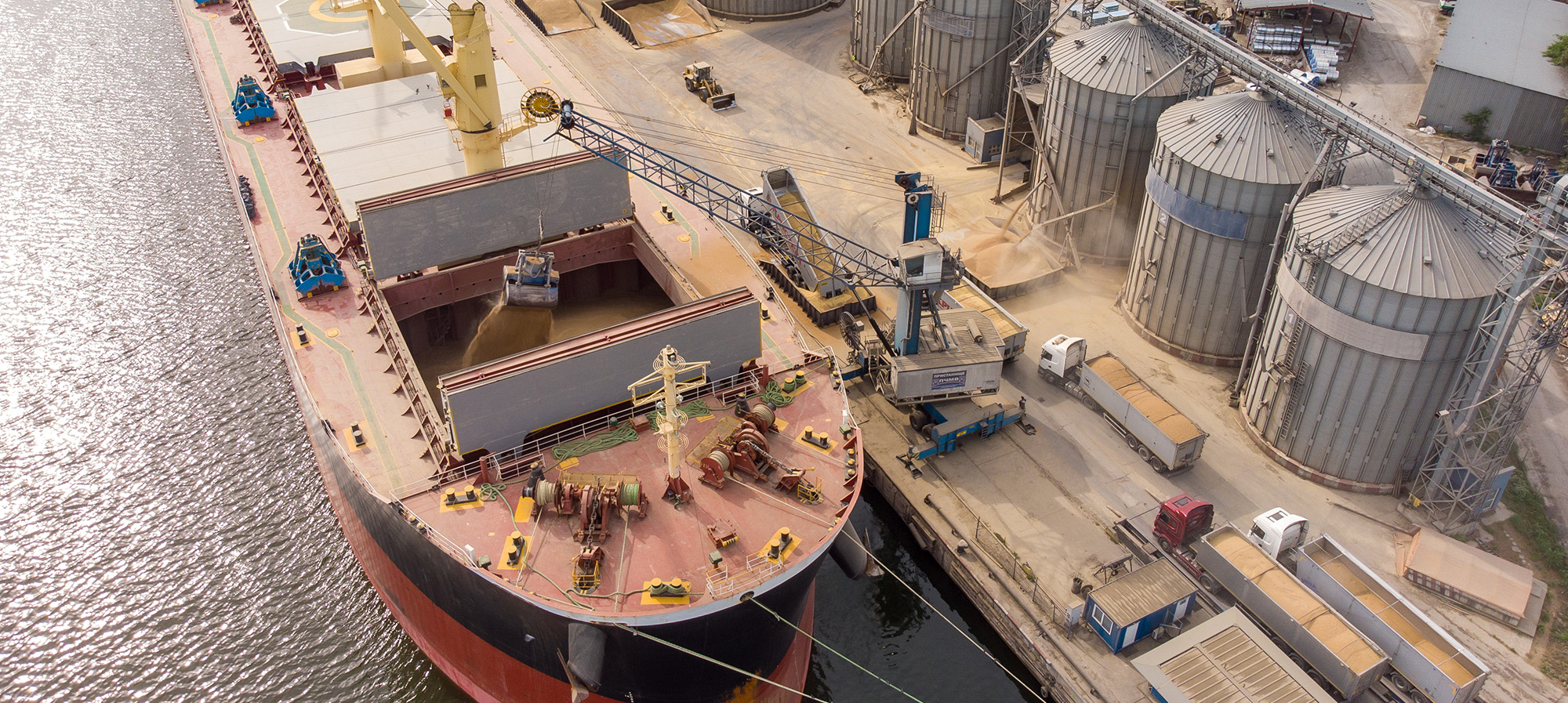

In the competitive world of bulk and general cargo terminal operations, efficiency and data visibility are no longer optional. They are the lifeblood of profitability and growth. Whether managing grain silos, fertilizer sheds, steel stockyards, or multipurpose berths, terminals face increasing demands to reduce cost, improve service, and demonstrate compliance and traceability. CommTrac is designed specifically for these challenges.
CommTrac is a leading terminal operating system (TOS) for bulk, breakbulk and general cargo terminals. Over the last 20 years, CommTrac has been deployed to over 40 terminals in the UK, Europe, USA, Australia and Africa.
This article sets out the business case for adopting CommTrac, showing how its proven performance translates into real financial and strategic advantage.
The operational challenge
Unlike container ports, bulk and general cargo terminals often rely on legacy spreadsheets, siloed systems, and manual reporting to manage operations. The result: limited visibility, inefficient coordination, and unrecorded losses. With rising cargo volumes, complex cargo types, and tighter margins, this operating model is no longer sustainable.
Demurrage penalties, missed billing opportunities, and unplanned downtime directly erode profits. At the same time, customers are demanding real-time progress updates and error-free documentation. The key question for operators is: how can we do more with the same resources while improving service and compliance? CommTrac provides the answer.
CommTrac’s proven performance gains
CommTrac brings digital transformation to bulk operations by integrating all core terminal activities (vessel, yard, truck, and rail) into a single platform. Its impact has been validated across over 40 varied terminal environments, consistently delivering the following measurable results:
Translating improvements into business value
Let’s translate these performance gains into financial outcomes, using realistic operating profiles for a typical small and large terminal. Clearly these numbers will vary largely between terminals depending on the commodities involved, the port’s location, and many other factors; however, we have tried to use values that could be found in a real-world terminal, based on our experience.
Scenario 1:
Small Bulk Terminal
• Annual throughput: 500,000 tons
• Revenue: £4 million / $5.3 million / €4.5 million
• Net margin: 12.5%
With CommTrac you would expect to improve the net margin as follows:

Scenario 2:
Large Bulk Terminal
• Annual throughput: 10 million tons
• Revenue: £100 million / $134 million / €115 million
• Net margin: 12.5%
With CommTrac you would expect to improve the net margin as follows:
Beyond the Numbers: Strategic and Operational Benefits
While the financial case alone is persuasive, CommTrac delivers broader strategic and risk-management advantages that strength then a terminal’s long-term competitiveness.
-
Enhanced visibility and decision-making
CommTrac provides real-time tracking of every cargo movement, vessel, and storage area. Managers can instantly see where bottlenecks are forming, how equipment is being utilised, and how closely operations are tracking to plan. That real-time visibility leads directly to faster, smarter decisions. -
Improved customer service and trust
Reducing customer claims by up to 90% doesn’t just protect revenue; it improves relationships and strengthens trust. Customers gain confidence that their cargo is being handled efficiently and transparently, with instant access to loading, discharge, and stock information. -
Future-proof scalability
CommTrac is designed to handle both manual and automated environments, across one or many terminals. As operators invest in automation, further integration, or additional sites, CommTrac scales seamlessly, protecting the investment and eliminating the need for separate systems. -
Simplified compliance and auditing
With automated data capture and workflow management, terminals can cut the time required for both quality and financial audits by half. That means less manual chasing for documentation, fewer discrepancies, and faster reporting to regulators and stakeholders. -
Data-driven continuous improvement
CommTrac doesn’t just digitise the current process — it unlocks analytical insight. Historical performance data enables terminals to identify recurring inefficiencies, forecast demand, and make evidence-based investment decisions. -
Implementation and change management
Successful deployment of any TOS depends on effective integration and user adoption. CommTrac’s modular architecture and configurable interfaces make integration with ERP systems, weighbridges, and automation equipment straightforward.
Key implementation considerations include:
-
Process alignment: Review and streamline existing workflows before digitisation.
-
Training and engagement: Engage operators and supervisors early to ensure smooth transition.
-
Phased rollout: Pilot in one terminal or cargo type before scaling across the network.
-
Performance tracking: Set baseline KPIs (e.g., demurrage, throughput, OPEX) so improvements can be measured from day one.
TBA provides dedicated implementation support and has a proven record of delivering operational readiness with minimal disruption, typically measured in weeks, not months.
The long-term business impact
Once CommTrac is embedded, its benefits extend beyond immediate financial gains:
-
Sustained productivity growth: By unlocking extra handling capacity, terminals can accommodate new customers and cargo types without costly infrastructure expansion.
-
Competitive differentiation: Faster turnaround times and transparent reporting attract new business in a competitive marketplace.
-
Resilience: With integrated data, terminals are better equipped to adapt to supply-chain volatility, weather disruptions, or shifts in commodity flows.
-
Sustainability: Optimised equipment deployment reduces idle running and fuel use, aligning with decarbonisation goals.
Conclusion
The evidence is compelling. CommTrac delivers quantifiable efficiency, cost, and service improvements that directly boost a terminal’s profitability and competitiveness. With up to 20% savings in demurrage and OPEX, a 20% increase in capacity, and significant reductions in claims, admin, and audit time, the return on investment is swift and substantial.
But beyond the numbers, CommTrac transforms how terminals operate: turning data into decisions, reducing risk, and freeing teams to focus on value creation rather than firefighting. For any terminal operator aiming to scale efficiently, enhance service, and protect margins, adopting CommTrac is not just a technology decision, it’s a business strategy.
Share this

The SaaS advantage: how TBA’s CommTrac TOS is transforming terminal operations
Five Years of Growth, Innovation, and the Power of CommTrac